-
Products
- Products
- Fire resistant cables
- Power cables 1-145 kV
- Building cables
- Pre-wired installation cables in conduits
-
Specialty LV cables and flexible cords
- Overview
- TITANEX® H07RN-F 450/750 V
- H03V2V2-F (RKK 90) 300/300 V
- H03VVH2-F (SKX-U) 300/300 V
- H05V2V2-F (RKK-S 90GR) 300/500 V
- H05VVH2-F (RKX) 300/500 V
- H05VV-F (RKK) 300/500 V
- H03V2V2H2-F (SKX-U 90GR) 300/300 V
- H03VV-F (SKK) 300/300 V
- PUREAX (H07BQ-F)
- RKX 90
- S03Z1Z1H2-F (SQX) 300/300 V
- H05Z1Z1-F (RQQ) 300/500 V
- Robotic lawnmower wire H05Z1-K (RQ) Tinned 300/500 V
- NOAC-E HFFR 300/500 V (S05Z1A7Z1-F)
- Telecom - LAN - security
- Industrial cabling
- Accessories
- Your business
- News
- Support and Tools
- We are Nexans
- Sustainability at Nexans
- Search
- Contact us
- Compare
- Sign in

Nexans Low Carbon Program
Data transparency supporting low-carbon innovation for sustainable choices
Nexans Low Carbon Program consists of a continuous innovation approach aimed at improving the environmental performance of Nexans products and services, based on environmental data transparency. Rolled out worldwide, this program applies to all Nexans products with a life cycle assessment (LCA). As part of this unique program, Nexans has implemented the first environmental labeling of its products' CO₂ data, easily accessible from the technical data sheets of products with a certified LCA. This is a pioneering initiative in the cable industry.
recycled copper in Nexans low-carbon cables worldwide by 2028
Nexans cables sold covered by PEP Ecopassport® declarations*
carbon emissions on aluminum products Nexans AML and Nexans AMCL **
*Share of revenue from products sold with PEP declarations in Europe and North America in 2025.
** Reduced climate impact compared with equivalent standard products, based on data from third-party verified PEP declarations. The comparison covers A1–A3 (raw materials and manufacturing) in accordance with EN 15804+A2.
AML: NXNS-00363-V01.01 compared with N1XE: NXNS-00362-V01.01
AMCL: NXNS-00238-V01.01 compared with Axclight: NXNS-00494-V01.01
Revealing what truly matters: low-carbon performance of cables
Although invisible to the naked eye, a cable's environmental footprint is yet real. It is present at every stage of its life cycle: from raw material sourcing to manufacturing, and from installation to end of life.
With its Low Carbon program, Nexans is committed to ensuring the transparency of its cables' environmental data by providing reliable information that allows the carbon footprint of a cable to be assessed at a glance. More than just information, it is a commitment to produce differently, with greater transparency and improved environmental performance.
It is the overall impact that a cable has on the environment throughout its life cycle. It is measured through life cycle assessments (LCA), certified by an external program and published in the form of Product Environmental Profile (PEP Ecopassport®) declarations.

Environmental data based on cable life cycle analysis
Designed to provide a quick and comprehensive overview, Nexans' environmental data display is based on a solid set of indicators stemming from life cycle assessments (LCA), a standardized evaluation method that provides a multi-criteria, multi-stage environmental assessment of the entire cable life cycle.

Raw material sourcing
Obtaining the raw materials needed to manufacture the cable, including transportation.
Manufacturing
Transforming raw materials into finished products.
Logistics and distribution
Transport, storage, and distribution of the cable from the manufacturing site to the point of consumption.
Use
Period during which the product is consumed by the end user
End of life
Treatment applied to the cable when it is no longer in use (reuse, recycling, disposal, etc.).
How to read a cable's environmental data?
4 clear indicators
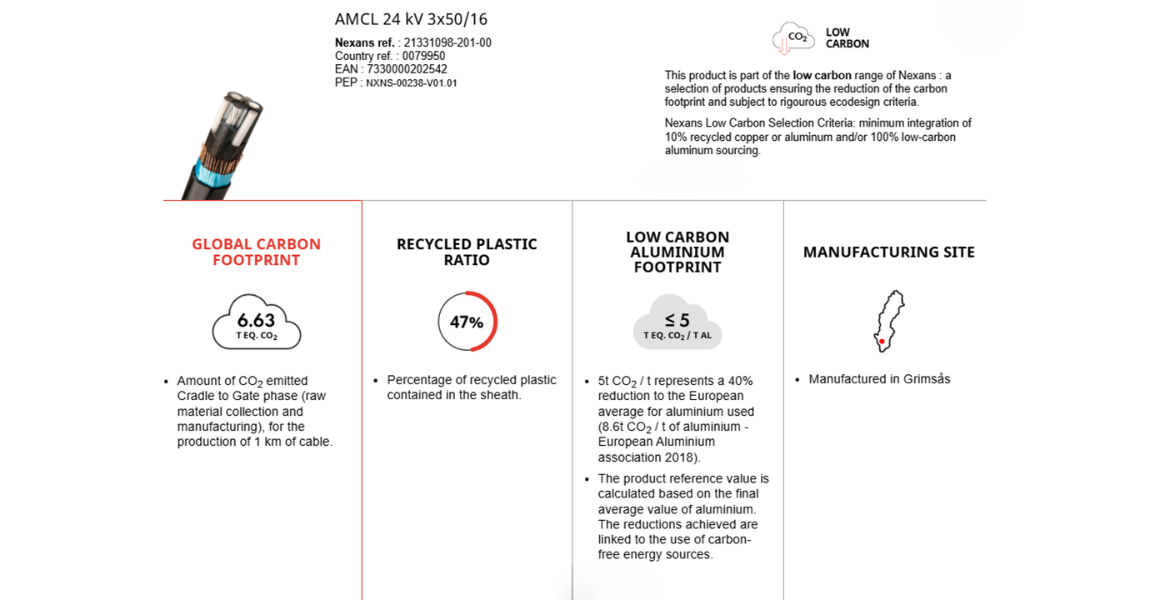
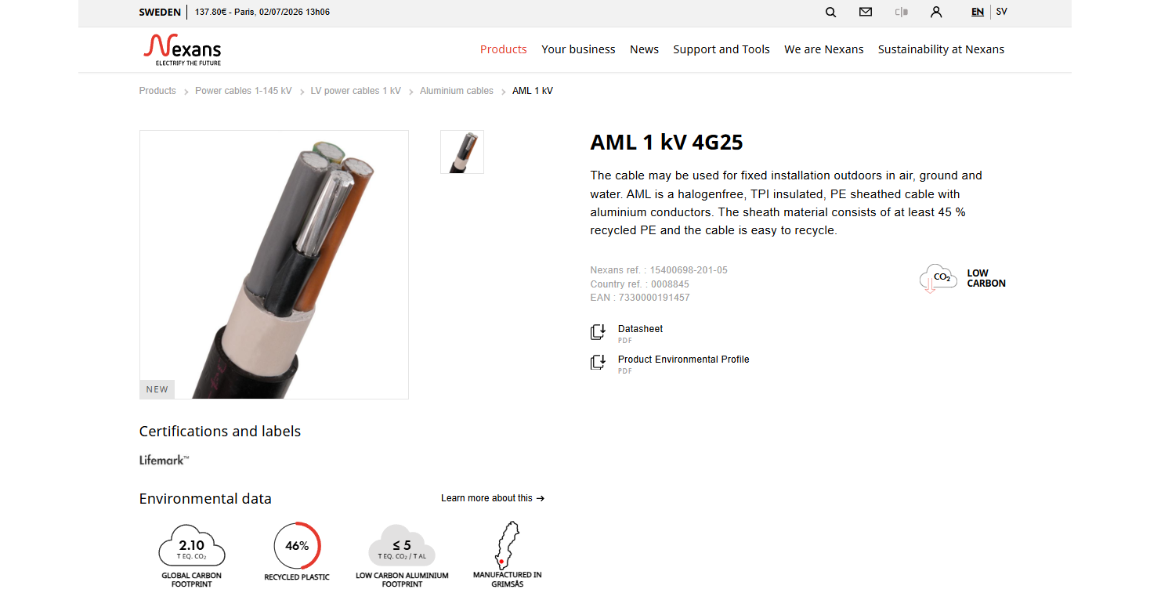
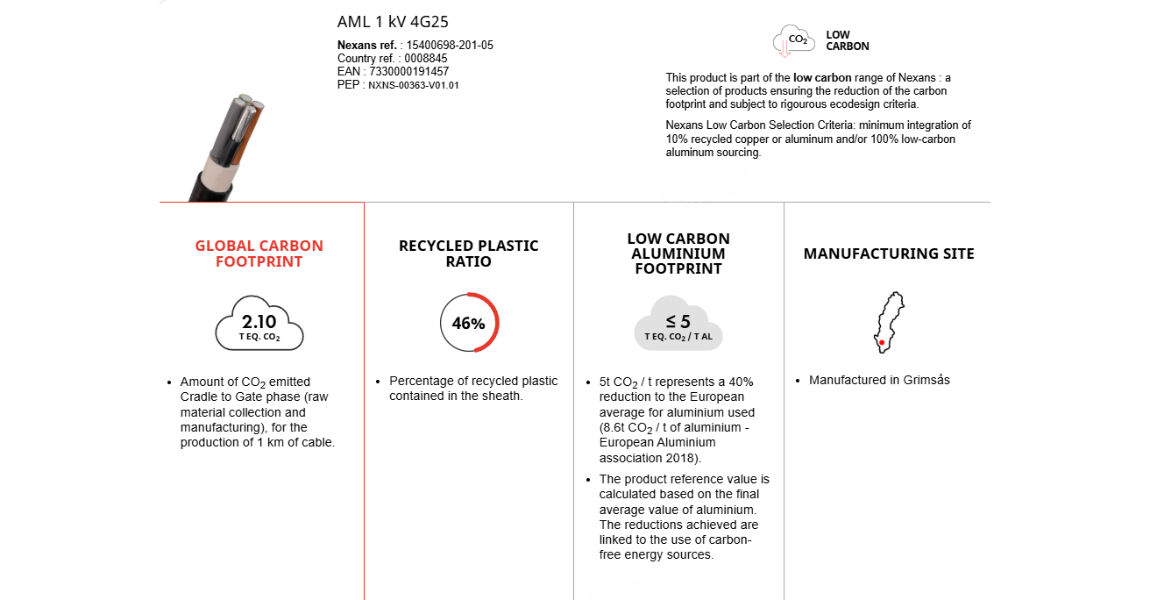
To facilitate access to and understanding of its cables' environmental data, Nexans displays the environmental information from the LCAs of its PEP-certified products in a simple format made of reliable data and a rich set of indicators:
- Simplified data display, easily accessible on products web pages with a third-party certified LCA;
- Reliable and structured data, derived from the Life Cycle Assessment of the product concerned;
- A rich set of indicators, allowing to assess products environmental performance at a glance.
Improving the environmental footprint of cables
In order to improve the environmental footprint of its cables, Nexans leverages on the most significant cradle-to-gate criteria that serve as the basis for the indicators displayed on environmental labels.
1. Integration of recycled materials
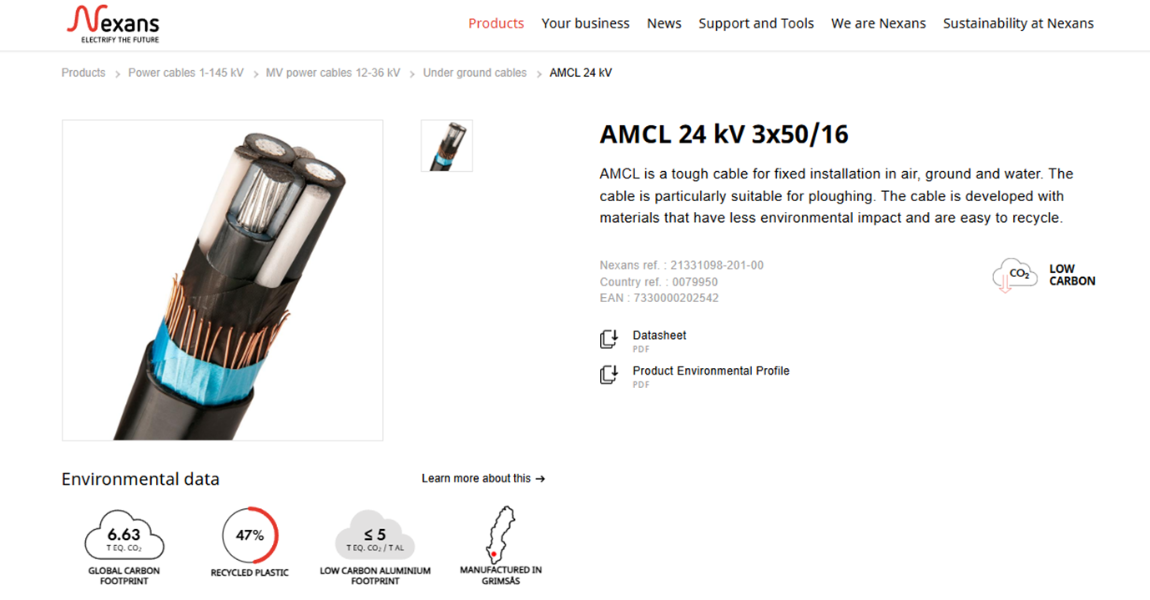
- Metal conductors account for between 70% and 90% of a cable's total cradle-to-gate carbon footprint. Integrating recycled copper or aluminum is therefore the most impactful lever for improvement.
- Integration of recycled materials and high purity requirements to guarantee the performance and compliance of low-carbon products.
2. Supply of low-carbon footprint aluminum
- Aluminum from production processes powered by a carbon-free energy mix (nuclear, solar, hydro, etc.).
- 100% of aluminum cables in France are made from decarbonized aluminium.
For example, activating these two levers has resulted in a 40% reduction in CO₂ emissions for aluminum products in the Nexans TWISTAL range in France* (CO₂ savings achieved on the Nexans U1000 AR2V TWISTAL 4x1x240 rALU product range (EcoPassport reference: NXNS-00040-V03.02-FR), compared to the same product reference without the improvements: recycled raw materials and aluminum produced using carbon-free energy).
Documentation
Our websites
Select your country to find our products and solutions
-
Africa
- Africa
- Ghana
- Ivory Coast
- Morocco
- North West Africa
- Americas
- Asia
- Europe
- Oceania